Newsletter Subscribe
Enter your email address below and subscribe to our newsletter

 Byjohn A
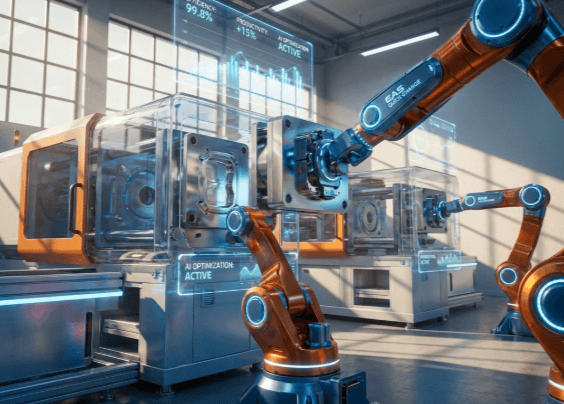
AI augments manufacturing productivity by turning diverse sensor data, telemetry, and historical records into prescriptive actions. It tightens control loops, shortens decision cadences, and elevates visibility, predictability, and governance. Real-time quality monitoring and predictive maintenance scale reliability while integrating asset health with production context. Responsible scaling requires clear ROI, auditable decisions, and upskilled teams. The result is autonomous, informed governance that continuously improves performance and compliance, inviting further inquiry into how these systems evolve.
AI introduces measurable gains across manufacturing by enhancing visibility, predictability, and control. Data-driven insights align processes with demand, reduce variance, and accelerate decision cadence. Systems thinking reveals interdependencies, enabling targeted optimization and scalable outcomes. Data governance ensures integrity and compliance, while workforce enablement expands human capability through upskilling and collaboration. The result is resilient productivity, empowered by clear metrics and autonomous, informed governance.
Across manufacturing operations, data-to-action pipelines translate sensing, telemetry, and historical records into prescriptive guidance that tightens control loops and shortens decision cadence. AI-enabled optimization maps insights into actionable workflows, aligning capacity, quality, and throughput. Considerations include ethics risk and data lineage, ensuring governance accompanies automation. The approach emphasizes measurable improvements, transparency, and scalable, system-wide decision processes that empower operators and engineers toward intelligent autonomy.
See also: petlixa
Real-time quality monitoring and predictive maintenance scale across manufacturing ecosystems by integrating sensor streams, asset health metrics, and production context to detect deviations and forecast failures before they disrupt output.
Systems synthesize edge latency data and centralized analytics to optimize maintenance windows, reduce downtime, and elevate throughput, while data governance ensures secure, auditable decision flows and scalable, freedom-aligned optimization.
Governance, skills, and ROI form the triad that underpins scalable AI adoption in manufacturing, aligning technical capabilities with corporate risk Appetite, regulatory requirements, and measurable value.
The approach emphasizes data governance to ensure trustworthy inputs, auditable decisions, and compliance.
Upskilling workforce capabilities enables cross-functional optimization, accelerates deployment cycles, and sustains ROI while maintaining resilience, clarity, and freedom to iterate.
AI resilience enables rapid disruption response by predicting supplier risk, optimizing inventories, and rerouting materials; collaboration metrics gauge cross-functional alignment, while AI-driven scenario planning fortifies supply chains against shocks, empowering organizations seeking freedom through data-informed resilience.
The upfront costs vary, but assets, integration, and governance shape investment; ROI timelines span quarters to years. The analysis tracks capital expenditure, operating savings, productivity gains, and risk-adjusted returns, guiding a freedom-seeking enterprise toward optimized, data-driven resilience.
AI safety mitigates risk through real-time monitoring, fail-safes, and contextual anomaly detection; automation ethics guides deployment, transparency, and accountability. Data-driven, systems-focused optimization ensures compliant workflows, empowering workers with safer, autonomy-aware environments.
AI models adapt to seasonality and demand volatility by learning patterns, updating forecasts, and adjusting production plans. AI adaptation supports Seasonality modeling and Demand volatility management with data-driven, optimization-minded transparency, enabling a freedom-friendly, resilient manufacturing system. Adaptation strategies, Demand variability
Data governance practices maximize AI effectiveness by enforcing robust data quality and transparent data lineage, enabling traceable decisions, reproducible experiments, and continuous optimization across systems while preserving autonomy and freedom to innovate within compliant boundaries.
In the factory’s evolving orchestra, AI conducts with data-driven precision, translating sensing rhythms into prescriptive actions. Systems interlock—quality, maintenance, and production—creating resilient, autonomous governance that tightens loops and lowers risk. As dashboards illuminate the path, history and forecast converge, guiding continuous optimization like a well-tuned machine. The result is scalable productivity, where insight becomes impact and every decision hums with quantified ROI, echoing a future where efficiency is both art and algorithm.